

Workforce Wednesday: First in Revolution and Institutionalization
Reckoning with Waypoint Adventure's Disability History Tour

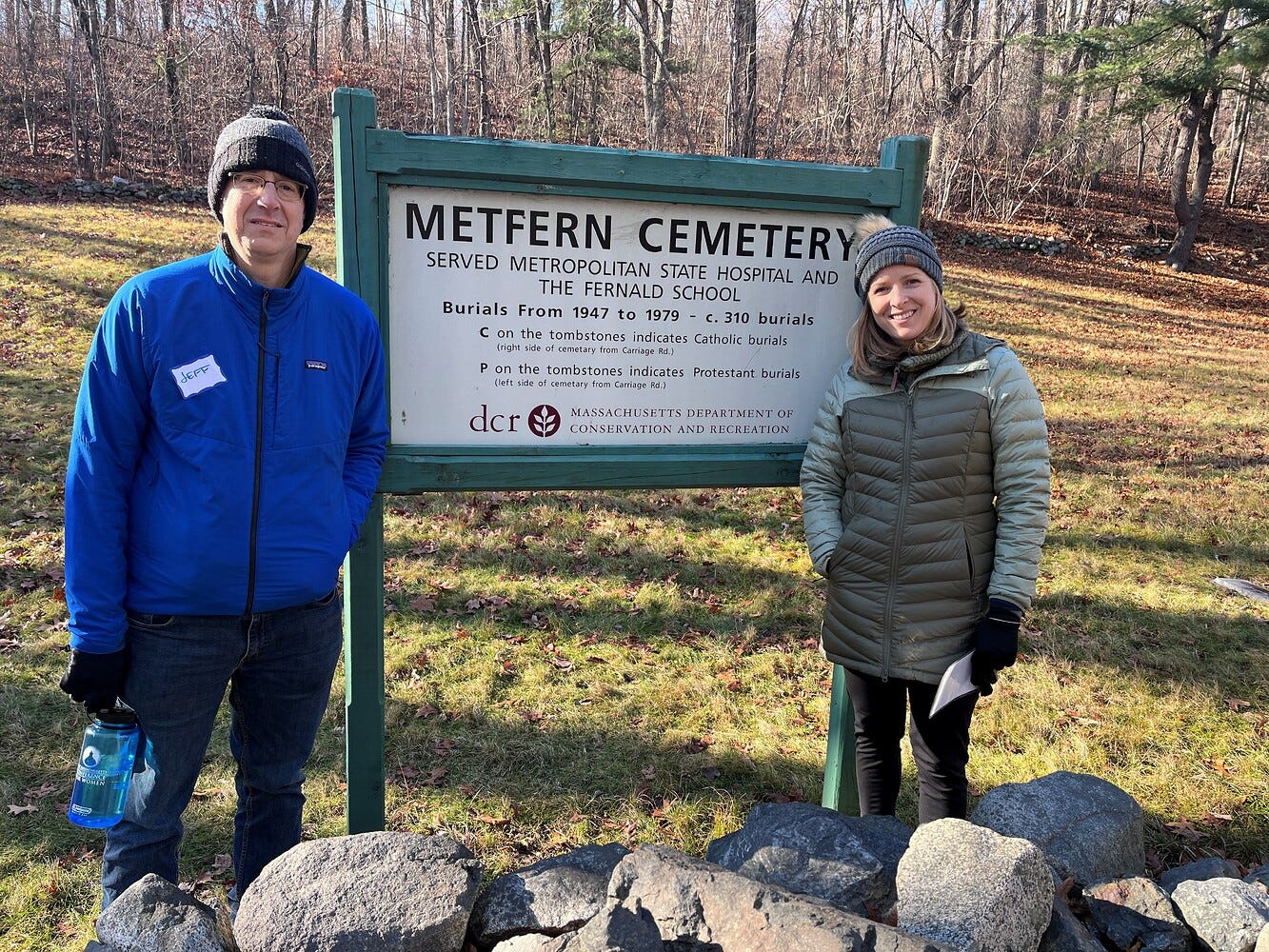
Photo Description: Jeff, on the left looking miserable and cold in blue, and Julia, smiling kindly in gray and green on the right, frame a state marker that says Metfern Cemetery.
Take a long look. That’s one of the most awkward photos of me in years. The snap endured fierce competition, because I have never been photogenic.
I look particularly pained for a good reason. I am standing with a colleague Julia Spruance, from a valued partner Waypoint Adventure and former fellow Kupenda Board of Directors Member, in front of an anodyne state sign for the Metfern Cemetery.
Inside the field stone walls of this cemetery are over 160 bodies of residents, students, and inmates of the former Metropolitan State Hospital and The Walter Fernald Developmental Center. These individuals were provided the dignity of burial by name. They were laid under rectangular stones that are marked by C for Catholic or P for Protestant and a number. The stones on the east edge of the cemetery, which is populated by Ps are larger and stand out of the earth a good four to six inches. Later burials are marked by smaller stones, as if the importance of these passings diminished as the years went by. Located in a wetlands meadow some of the stones have sunk beyond visibility entirely.
Massachusetts is nothing without its history. Ken Burns’ current PBS series will correct you if you have any doubts. The disability community has long known Massachusetts as first in revolution and institutionalization. Just over the hill from the Metfern Cemetery stood the Walter E. Fernald Developmental Center, which was relocated to this site from south Boston in 1887 and was once home to some of the most progressive educators of people with disabilities in the country. As documented so well in my friend Alex Green’s essential biography of Fernald, the early educators believed deeply in the ability of people with significant intellectual and developmental disabilities to learn the skills they would need to learn, work, and live a full life. The educators developed brilliant new strategies focused on object lessons and scaffolded curricula in order to engage and enlighten their students. The educational approach was developed in parallel with – and perhaps partially influenced by – Maria Montessori and similar strategies are still used by schools that bear her name today. Montessori Schools today. But the road to hell is not only paved with good intentions, it also takes people with disabilities down a way that narrows, slows, and often leads to far greater controls. In the Fernald Center of the nineteenth and twentieth century or many group homes and day programs today, we learn again that separate but equal never is.
By the early twentieth century, the capacity of this beautifully built school situated in a bucolic land, significantly expanded. The number of long-term residents, often referred to as custodial cases, started to outstrip the numbers of students. It became difficult to distinguish students from inmates. In addition to serving people with significant intellectual disabilities or challenging medical diagnoses like epilepsy, the Fernald often provided custodial care for orphans, children of alcoholics, and students with a history of disruptive behavior.[1] Far from being educated in the creative ways that Fernald had initially intended, children and adult residents with a broader array of skills were often treated as unpaid labor. They worked the fields that fed the institution and provided personal care to residents in wards where there were often dozens of patients for each staff member on duty.
The scale of people who were confined to Fernald, this site is just a mile or two off of the interstate that I use to drive to work most Tuesdays and Thursdays, is difficult to comprehend. Alex Green estimates that over 15,000 individuals resided at the institution over the 162 years of its operation. On the more recent horizon, a woman who joined the brilliant tour that Julia and I, along with twenty or so others, took on that cold Monday, said that when she worked at Fernald in the 1970s – within my lifetime – there were over 3,000 residents on the site. While Fernald was the first institution for people with disabilities, often called state schools, in Massachusetts, it was far from the last. Fernald also founded the Templeton Farm colony which produced much of the food for the institution. In Belchertown, Bridgewater, Danvers, and Tewksbury other institutions, a mix of state schools and sanitariums, sprang up across the commonwealth. Massachusetts, first in freedom and institutionalization, was followed by other states. At its peak, some 300,000 Americans lived their days this way.
Throughout my life these institutions have been right around the corner. In Lincoln, Illinois, Newtown, Connecticut, and Beverly, Massachusetts the institutions were in town or the one adjacent. Although I was increasingly pulled towards serving the disability community, in sheltered workshop in Tulsa, downtown Toronto residence and community, and a Malden employment program dedicated to escaping the gravity of institutionalization, the fact that tens of thousands of people with disabilities[2] –– languished in these segregated zones was something I rarely focused upon. The mass segregation and often brutal treatment of my people resided on my periphery.
To be continued in two weeks.
[1] Terrifying for a guy sent to the vice principals office over 40 times in the eighth grade.
[2] Who I would later, at John Winske’s express invitation, come to identify as my people, not the objects of my service.
Very powerful Jeff…thank you for this…