

Workforce Wednesday
First in Revolution and Institutionalization, Pt. 2

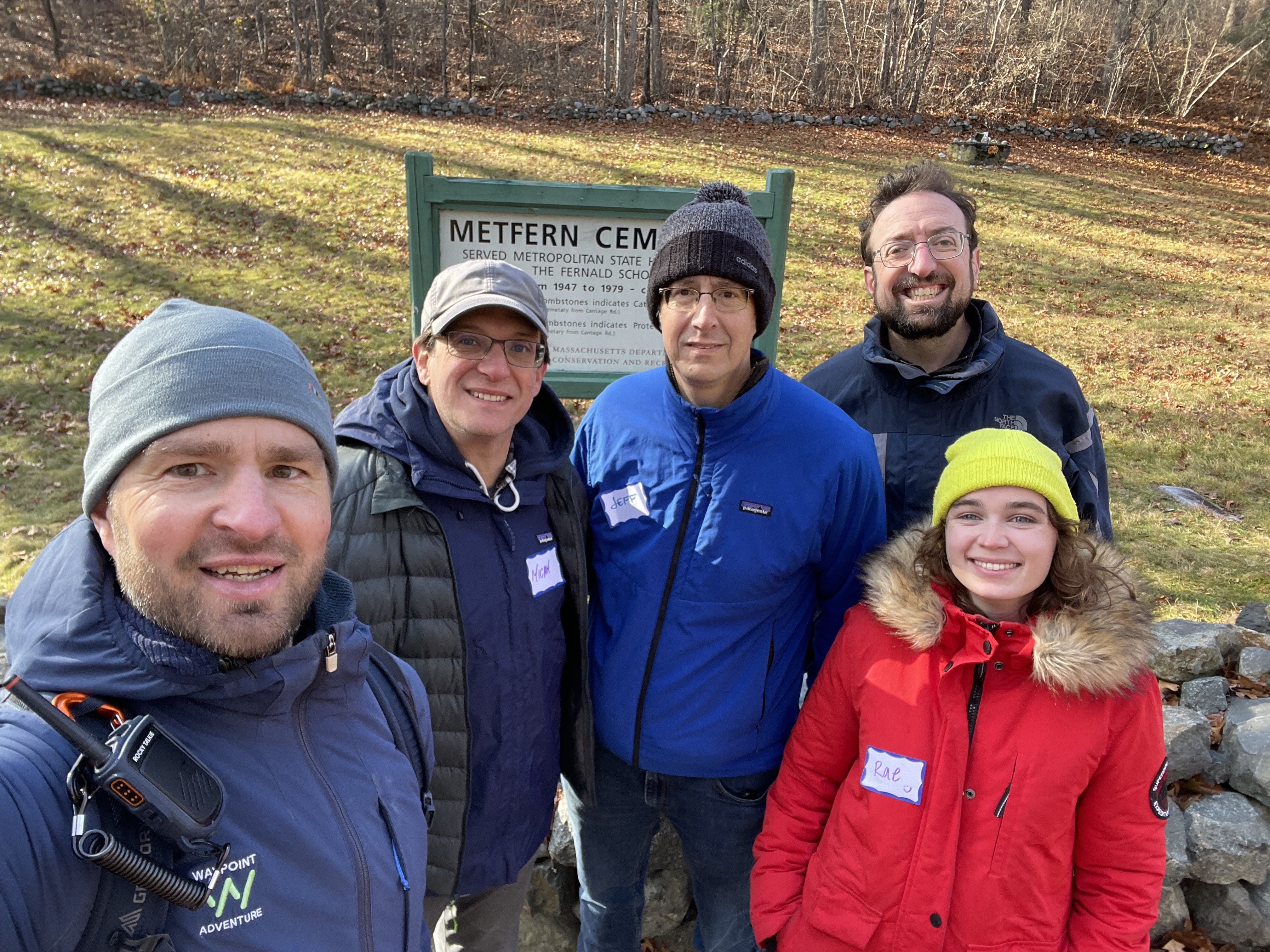
Photo Description: A photo taken during the Disability History Hike that was organized by Dan Minnich of Waypoint Adventure, far left, scripted by Rae, in red at right, and inspired by the research of Alex Green, in the back and on the right. I’m standing with Micah Fleisig, invaluable colleague and one of my self-appointed handlers, on my left.
Writers Note: Before sharing the second part of this story, I wanted to let you know that this week Alex Green’s excellent biography, A Perfect Turmoil: Walter E. Fernald and the Struggle to Care for America’s Disabled, has been included on the long list for the National Book Critic’s 2025 Biography Award. You should stop reading this post and pick up Alex’s book. I am definitely planning on reading it again.
—
The legacy of the institutions - as the Waypoint tour so creatively highlighted - were usually ones of idealism followed by decay. Although I cannot testify to his or anyone else’s intentions, Walter Fernald sure seemed to start and end his career with the belief that people with disabilities could be educated, employed, active participants in society. In that horrible gap between his belief and the realities he helped create are legacies of preventable deaths,[1] dalliances with eugenics, and thousands of lives spent on urine soaked floors similar to those that Fernald found when he accepted the superintendent position at the Massachusetts School for the Feeble Minded in 1887.
This was not my first visit to Fernald. I was there on a cold December night in 2021 when we were protesting a charity Christmas lights show that the mayor of Waltham allowed on these hallowed grounds turned city owned property without any input from the disability community. A little further back, Triangle, the disability organization I proudly served for many years, played a role in sourcing product or fiscally managing a recycling center at Fernald. If memory serves the recycling center provided subminimum wage paying jobs for people with disabilities who had a past history of acting violently or in sexually inappropriate ways. If that was indeed the profile of people served it is hard not to think about how the individual’s past behavior related to their own experience of abuse. We know that hurt people, hurt people. Many people who sexually abuse have also been victims of such abuse. Since work is a force that gives us meaning as well as money, there is something truly valuable about providing work opportunities for people in such a predicament. Though one wishes that work opportunities had been provided in a less segregated and isolated environment. It is hard not to see how the practice of segregation produces more segregation.
Later in his life, Fernald truly seemed to lament the channel he had cut out of the cities and towns where people with disabilities had lived in order to channel their lives into instiutions like the one he developed in Waltham, Templeton, and elsewhere. Once cut, the flow of lives rushing into these institutions could not be reversed. As one of our tour guides on that cold Monday reminded us, in Fernald’s last published work in the 1920s, he expressed that his long experience educating and working with people with disabilities had convinced him that the majority of people with disabilities could live and work in their communities. In the same piece, Fernald projected that it would be a hundred years before the reign of institutions ended. Sadly, Fernald was correct on both counts. The institution that bore his name only ceased operation in 2014. The institution’s closure was long delayed by the families of residents, many of whom had significant medical needs, who had lived there for many years, which is understandable, and by the advocacy of state employee unions for longitudinal employment,[2] which is not.
Around the time of Fernald’s closure I also had the privilege of working with several former residents of Fernald, including my friend C, who spent her early years in Fernald and most of her adult years living independently in affordable housing in Malden, where she took the MBTA to work every day. C’s early years should not have been spent in an institution. Nor should most of her working years been spent in a segregated, sub-minimum paying sheltered workshop. Once segregated, the path back towards integration is often so long and painful.
I am no friend of institutionalization, whether pursued in state schools in the past or nursing homes[3] and many under-resourced and poorly run group homes in the present. But I can empathize with Walter Fernald as a leader. As detailed so carefully in Alex Green’s book, Fernald is a man who started with a passionate belief in the capabilities of people with disabilities and he consistently worked to the point of exhaustion, perhaps contributing to his early death. Was he driven by ambition as well as idealism? I have little doubt. Hearts fired by ideals are not exempt from except from Frederick Buechner’s version of St. Godric, who asserts that “nothing human’s not a broth of false and true.”
I am terrified by the unintentional impacts of Fernald’s ambition. He is far from the only person who set out with great ambition, only to see many people - in his case, hundreds of thousands - suffer the consequences of his work. Like Fernald, albeit on a far smaller scale, I have sought to ally myself to the disability community and I have worked relentlessly for their advancement in the workforce. I have experienced some successes over the past nineteen years and have rejoiced in the work that my colleagues and I have done to connect hundreds of people with disabilities to employment. However, I am constantly reminded of how far my aspirations for the disability community outstrip my reach. This realization tempts me to work even more frantically as the years left in my career dwindle. I know that an ambitious idealist on the clock can easily center myself instead of the community I love and am called to serve.
Fernald’s story is far from the only warning I have received. I return to Dan Barry’s The Boys in the Bunkhouse time and again because I think that Kenneth J. Henry, the proprietor of the Henry’s Turkey Service, a Texas social enterprise founded in the 1970’s whose business devolved over subsequent decades into boarding adults with disabilities in a roach infested former school house while they worked for sub-minimum wages that were mostly garnished to pay their caretaker and enrich the proprietor, also started with the best of intentions. What young Texans in the 1970s would not rather work and make their own way rather than live in some godforsaken state school on some wind scoured parcel in their home state? Convinced he was doing right by “the boys” who had logged twenty or thirty year careers by the early 2000s, Henry farmed them out as contract labor, sustained his business on their backs, and failed to fulfill the meager promise of a retirement that he had made. A western themed group home retirement overseen by the man whose family had profited from their labor would not happen for the men whose labor was sold to factories in West Liberty, Iowa and Newberry, South Carolina.
When will my ambition outstrip my aspirations for those I serve? I repeat the mantra “those who set out to write about the world end up writing about the bricks in their garden, but those who set out to write about the bricks in their garden end up writing about the world,” hoping that the words will help me maintain focus on the person in front of me.
But my pursuit of a more equitable and inclusive workforce requires more than excellent individualized career coaching. The work requires constant negotiation with markets, state funders, families, and school systems, while simultaneously pursuing as many employment and advancement opportunities as possible for the individuals we are committed to serving.
As Fernald warns, channeling ambition to serve more noble aspirations is no small feat. There are practices like silent meditation, demanding unfettered feedback from my family and beloved, self-assigned “handlers,” and sharing the struggle on these pages that can help. When it comes to the work, I am confident about where we are going.
But with forbears like Fernald and Henry ever in mind, I’m proceeding with fear and trembling.
[1] Including the death due to second degree burns from a shower that I heard about on this tour.
[2] We know that negotiations with state employee unions kept many institutions and their close cousin, prisons, open far past their due date. People in our field, especially those of us who are more progressive, rarely talk about the role unions played in keeping institutions open. But surely, one can be pro-union and highly critical of this tactic.
[3] Which are still used to house many people with significant disabilities far in advance of their elderly years.