

Workforce Wednesday
Calling: An Inductive Approach

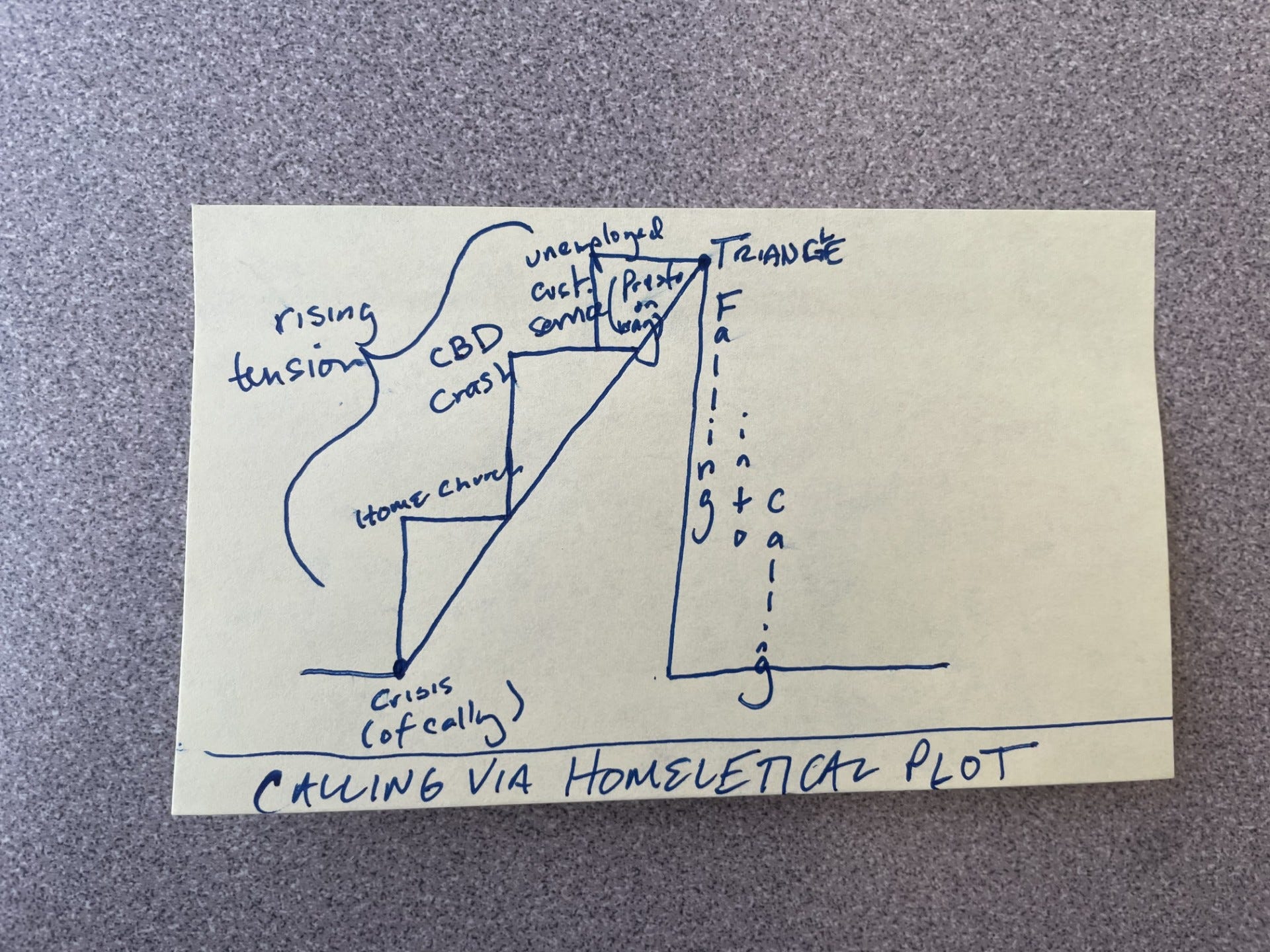
Image Description: A poorly rendered inductive plotting of my calling as I understand it. The plotting is in blue ink on a yellow sticky note. Further details below.
When I was training as a preacher, they gave us two models, the deductive and the inductive, for sermons. The deductive model is very similar to the five-paragraph essay model that we learned in high school. Thesis or topic sentence on top, example, example, story illustration or poem, and conclusion. Here’s what I’m going to tell you, here’s what I told you, here’s what to do with what I told you, and here’s a fun way to summarize my message. This is a traditional model for evangelical American preaching. It’s recognizable, it’s comfortable, it’s boring.
The other model, which had been in vogue in mainstream protestant pulpits for some time, but was relatively new to evangelical pastors, was the inductive model. If the deductive model is a pyramid right side up with the thesis on top, the inductive is an inverted pyramid[1] with a base of observations, ideas, and illustrations, tapering down to the thesis or an idea at the bottom. Another way to frame the inductive model is that it starts with disruption and then works its way towards resolution. The hard to decipher Post-It above is one way to model the inductive movement from disruption to resolution via rising tension.
It probably will not surprise you which model I preferred. Although I no longer preach - I think it has been at least 14 years since I have given a traditional sermon[2] - I still use this inductive model on a regular basis. For instance, late last December we had a graduation of our Transitions to Work internship to employment program at Brockton Hospital. The room was filled with people in a festive mood. An unrepentant holiday hater,[3] I noticed how many people had snowmen, snowflakes, or Christmas lights on or about their person. After warmly greeting the crowd at the end of the graduation I admitted that “I hate the holidays.”
This statement popped a few eyes and produced at least one audible intake of breath. After quickly bemoaning the disruptive inefficiencies of the season, I went on to talk about how the commitment of the students to their internships was impressive. I continued by talking about the dedication and palpable passion Brockton Hospital staff displayed in training their interns and getting them on track for employment. I added to this by talking about how the invaluable contributions of my staff and the consistent, undeniable support of the parents and partner educators in the room warmed my heart. I then concluded with “This is my holiday.” I spoke a few more words about why the inclusion of people with disabilities in the workforce is a light in my darkness and sat down.
Ta da! An inductive sermon. From the reports that I heard, it was an effective one. But you can see how easily it could have bombed.[4] For my money, one of the most effective current practitioners of this model is the comedian Bill Burr. He’ll throw out a controversial premise like “I hate Republicans,” list his reasons, double down on the disruption with, “but I hate Democrats more,” and then will wind you towards his perspective on how we can attempt to make some sense of an American political situation that feels just short of ideological war.[5] You might agree with Bill or you might not, but you’ll likely be compelled by his narrative.
What does this have to do with calling? Quite a lot, I suspect.
Everyone wants to have a meaningful life and, as Jim Collins wisely teaches us, that is hard to accomplish without meaningful work. Think back to those myriad conversations you had in your early twenties with friends where you talked on long walks, over drinks, or between puffs of Marlboro Lights about what you were going to do with your life.
These conversations were probably painful for most people. But allow me to think that they were particularly so for young white Evangelicals like me who had dedicated their life to Jesus and Christian ministry only to find that our elders only wanted us to do so in a deductive way. “This is what we believe about Jesus and once we get everyone to subscribe to these beliefs, we will redeem the world. Now tell the same story, without any deviation and bring in enough of the redeemed to buttress our bottom line. Take the same acquisition attempt to the very ends of the earth. Amen!”
By the end of the twentieth century the profound impacts of globalization that were catalyzed by two World Wars had influenced young Christians even in the American heartland. Our growing exposure to what was beautiful, good, and true about our global and our gay neighbors washed over and wore down the walls of ideological certainty that had been erected to separate the sacred from the secular world. Many of us were inspired by the Sermon on the Mount, exposure to St. Francis, and explicit or implicit knowledge of Foucault to call out and question the powers and the principalities in our world. That the defeat of a wholly carcinogenic nationalism by a slightly more benign variety had resulted in multiple failed wars of the military or social sort only heightened our suspicion.
Baptized and catechized in the church we were still in love with Jesus. But many of my privileged, white, educated, American male evangelical sort were unwilling to present a one-dimensional savior to the global world. And surrendering our faith in the Savior who was killed by a collab of state and faith to prop up the idea of America as a Christian nation? Forget about it.
As the height of rising tension above suggests, at 30, I had just been laid off from a customer service job,[6] had decided to forego paid Christian ministry,[7] and Kellie was pregnant with Preston, our first child. In retrospect, I should have been more terrified than I was. Fortunately, through Monster.com I scored an interview with a nonprofit in Malden, a city north of Boston that I could not have located on a map.
[1] All of this pyramid talk has me singing “Pink Triangle” from Weezer’s second album, Pinkerton, in my head. That album is also a call back to my time in Bible College.
[2] And yes, I still feel this loss in my bones. Check out the title of this Substack, for God’s sake.
[3] Thanksgiving and Opening Day are exceptions.
[4] Indeed, for some listeners it likely did. Probably 20% walked away thinking that I lived somewhere on the Scrooge to Asshole continuum. I’m more than happy with winning around 80% of the constituency in any situation.
[5] Though maybe, just maybe, the murder of Renee Nicole Good and Alex Pretti by the masked secret police will break the fever.
[6] At a company I did not mind seeing go out of business.
[7] Which I had spent was years training for and was the only thing I was credentialed to do.