

Workforce Wednesday
Exploring Calling in the Disability Community

I’ve been debating whether I should present at the National Association of People Supporting Employment First National Conference this June. I feel like I am a year out from presenting on the current work that we are doing to create an array of career development support for 14 - 30 year old transition age young adults in Brockton. I am starting to think that I should present on the formation, values, and skills that are required to develop and sustain a long term career in our field. That Venn Diagram that includes the elements of workforce development services, fiscal sustainability, and advocacy and intersects at the point of communion is the image that might shape and guide my proposal.
Maybe I present several models for understanding career development - or at least two. The Homiletical Plot, which is described in Eugene Lowry’s wonderful book of the same name, is structured much like Campbell’s hero’s journey with conflict, rising tension, denouement, and cascading consequences, makes sense. The homiletical hero’s journey for career development. I am into that. Presenting these models would have dual value for workforce professionals since they could help the professionals increase their understanding of their own career and they could utilize the tools with their clients. Indulge me as I scope out a potential proposal below.
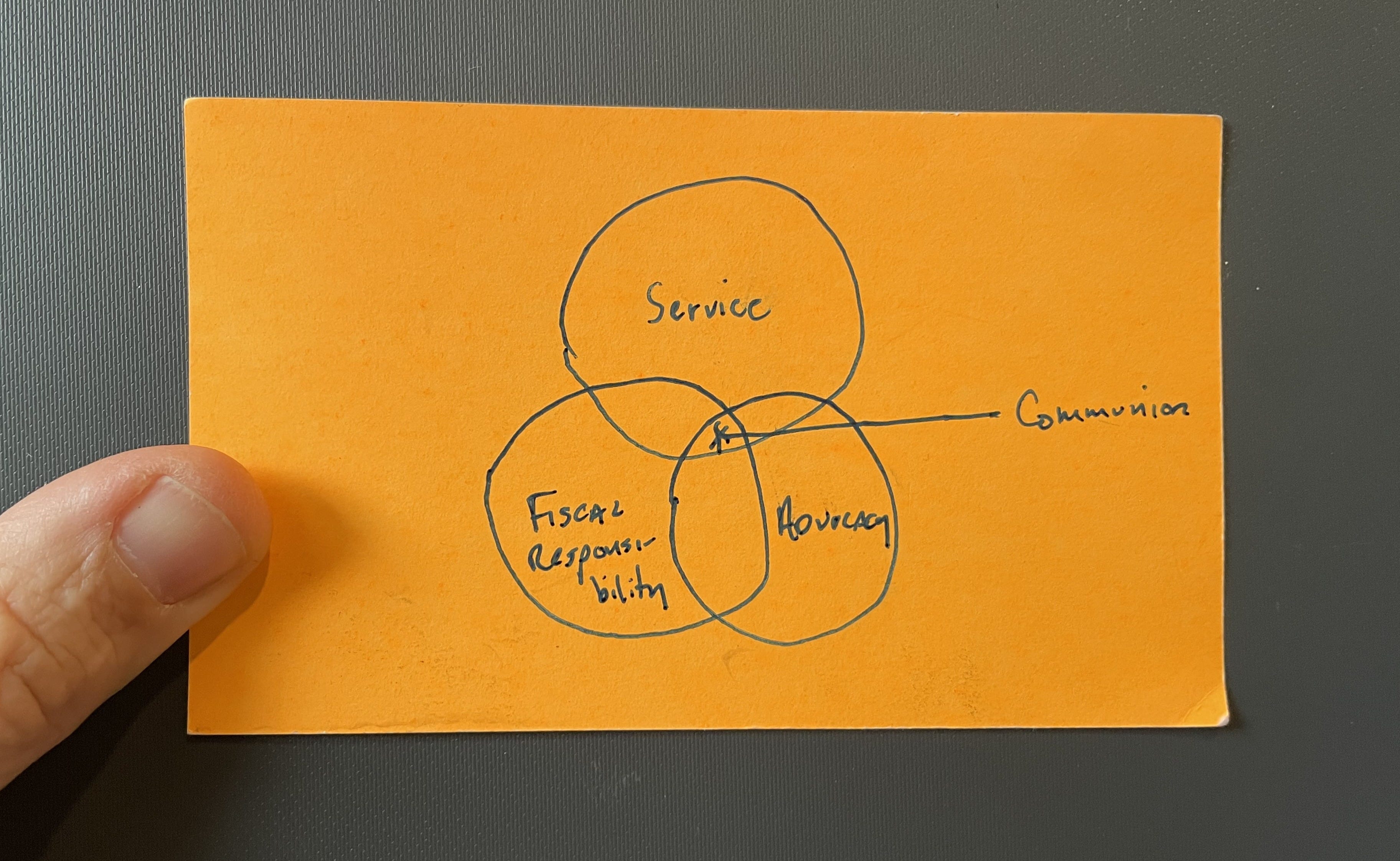
Picture Description: a shoddily drawn Venn Diagram on an orange index card. There are three elements in the diagram that are represented by circles. The top element is named service, the bottom left element is named fiscal responsibility, and the bottom right element is named advocacy. The intersection or overlap of the elements is identified as communion.
If I think about my calling to disability service work as a Venn Diagram, I suspect that it has the following elements[1]: service, advocacy, and fiscal responsibility.
Take a moment and think about what your elements would be.
If I was naming the intersection[2] I think I would name it communion. Communion was the world that my church used for the weekly practice of the Eucharist. Although I grew up in an evangelical Protestant tradition formed on the democratic western frontier of the religious revival often referred to as the second great awakening, our church shared in the body and blood of Christ every week. I am very grateful for this practice of the Christian Church, Churches of Christ tradition that was reinforced by my later interest in Roman Catholicism[3] and the Episcopal Church. The word communion also brings to mind the Civil Rights era’s emphasis on the Beloved Community, which is where I definitely long to dwell.
Take a moment to draft a name for your intersection.
A quick glance at my Venn Diagram suggests to me that I am currently over invested in the areas of service and fiscal sustainability and I need to increase my presence in the advocacy space. Thus, I will explore the advocacy circle a bit here.
There are multiple advocacy efforts in the fight for disability rights that are important to me. These include the work of the independent living centers like Boston Center for Independent Living[4] and Disability Policy Consortium that provide vital policy advocacy for the large, diverse disability community in Massachusetts. The advocacy of BCIL and DPC often overlap and sometimes extend beyond the policy priorities of organizations that serve people with more profound intellectual and developmental disabilities and autism. The interests of the latter communities, where I have invested most of my career, are fiercely supported by The Arc of Massachusetts and advocacy organizations focused on specific disabilities like The Massachusetts Down Syndrome Congress and Autism Families Association of Massachusetts. Increasing my partnership with the latter organizations is a key way that I can amplify my advocacy.
What does a deeper investment in advocacy in Massachusetts[5] look like? Surely it is studying the policy priorities of JVS Boston, The Arc of Massachusetts, the Association of People Supporting Employment First, Disability Policy Consortium, and the Boston Center for Independent Living, then deciding where I will invest my voice, resources, and energy. Most of these policy priorities will focus on the state level, but there are a few priorities, like speaking up clearly for section 504 of the Rehabilitation Act and the related Olmstead decision (check out the shit show that the great state of Texas and 8 other states are brewing on this front in Alex Green’s most recent post), that will have federal implications. Unless I create space for advocacy in my weekly schedule, it will never become a priority. The daily demands of service and the existential requirements of fiscal sustainability will extinguish half measure advocacy efforts. I also need to build out a schedule of advocacy events with organizations like the Disability Policy Consortium[6] and the Arc of Massachusetts[7] to make sure that I am present to support their policy priorities at the statehouse. Failure to prioritize advocacy limits my participation in communion. For this reason, I must increase my investment in this area.
Fiscal responsibility is boring to write about. People don’t go into accounting for compelling literature. However, in capitalist environments strong, diverse revenue streams and careful, creative cost controls are required to develop a thriving nonprofit. The discipline of cultivating philanthropic revenue streams and maximizing allocated state revenues, while simultaneously carefully controlling costs was one of the greatest gifts I received during my time at Triangle. In that environment, which in my first eight or nine years had a more entrepreneurial than an institutional human service standard bent, I was able to operate my divisions freely as long as I produced a 15% margin of expenses over revenues. This freedom allowed me to cultivate nonprofit leaders in a pay for performance manner than differed significantly than human service standard contexts. It also sparked innovation, which strengthened our financial prospects since foundations and philanthropists are often drawn to the cult of the new.
Triangle’s focus on innovation and incentivizing leadership talent with a deep investment in the mission had its downsides. The lack of strong, stratified salary bands created friction between management and direct care staff. This made it difficult to retain dedicated direct care staff who were more focused on professional stability than growth. In a few instances, I think that friction could have been reduced by a few of the leaders, starting with me, finding creative ways to remain practitioners. During my years at JVS I have corrected for that error. I think that clearer salary bands paired with significant flexibility in the raises provided to high achievers, could have cooled what could be a contentious environment at Triangle. But I’ll stop autopsying the past. Suffice to say, I am grateful for the financial skills that I acquired during that season, and I am so very proud of initiatives like Ability:IMPACT, The Accessible Icon Project, and EPIC Service Warriors, that I played a role in. Little resonances of those days, like Massachusetts using the Accessible Icon for the new disability parking placard in Massachusetts bring me great joy.
I have more to say about the element of service and the intersection of communion. I am also excited to explore calling through the lens of Lowry’s Homiletical Plot. But there are only so many hours in a day. To be continued in a week or so.
[1] In Venn diagram language, elements are the circles.
[2] In Venn language, the section of overlap of the three circles is called the intersection.
[3] Loved St. Francis, loathed the magisterium and the patriarchy.
[4] If the work of the Independent Living Centers is new to you, as it was to me when I discovered it six or seven years into my work with a disability provider organization, you can read up about it by pulling up the Wikipedia on Ed Roberts, watching Crip Camp, or reading Becoming Heumann by Judy Heumann, with Kristen Joiner.
[5] I am also passionate about supporting advocacy - and the fiscal sustainability and services for that matter - on the international front by organizations like Kupenda for the Children. I have been privileged to serve on the board of Kupenda for over 14 years and I am still excited about its mission. Fortunately, the advocacy work of Kupenda is primarily accomplished by our incredible staff on the ground in western Kenya. The work of Kupenda’s remarkable American staff and supporting Board of Directors is to attract enough funding to catalyze the direct advocacy, education access, and connections to medical support that our Kenyan colleagues provide. Our American staff also strategically collaborate with our staff on the ground to develop and test student and community education models that can be shared with organizations in other regions. I am tempted to go on and on about Kupenda, but this is not the place.
[6] NB: They have a legislative education session happening at the state house soon.
[7] NB: Their advocacy day with the Massachusetts Developmental Disabilities Council is coming up. Get it on the calendar.
I really appreciate the word description of the picture because I could not read your drawing.
You're absolutely right about needing to protect time when you prioritize advocacy, otherwise it will never get done. As a former colleague used to say, we need to prioritize the important as opposed to the merely urgent.