

Workforce Wednesday
Bad Dreams and Best Intentions

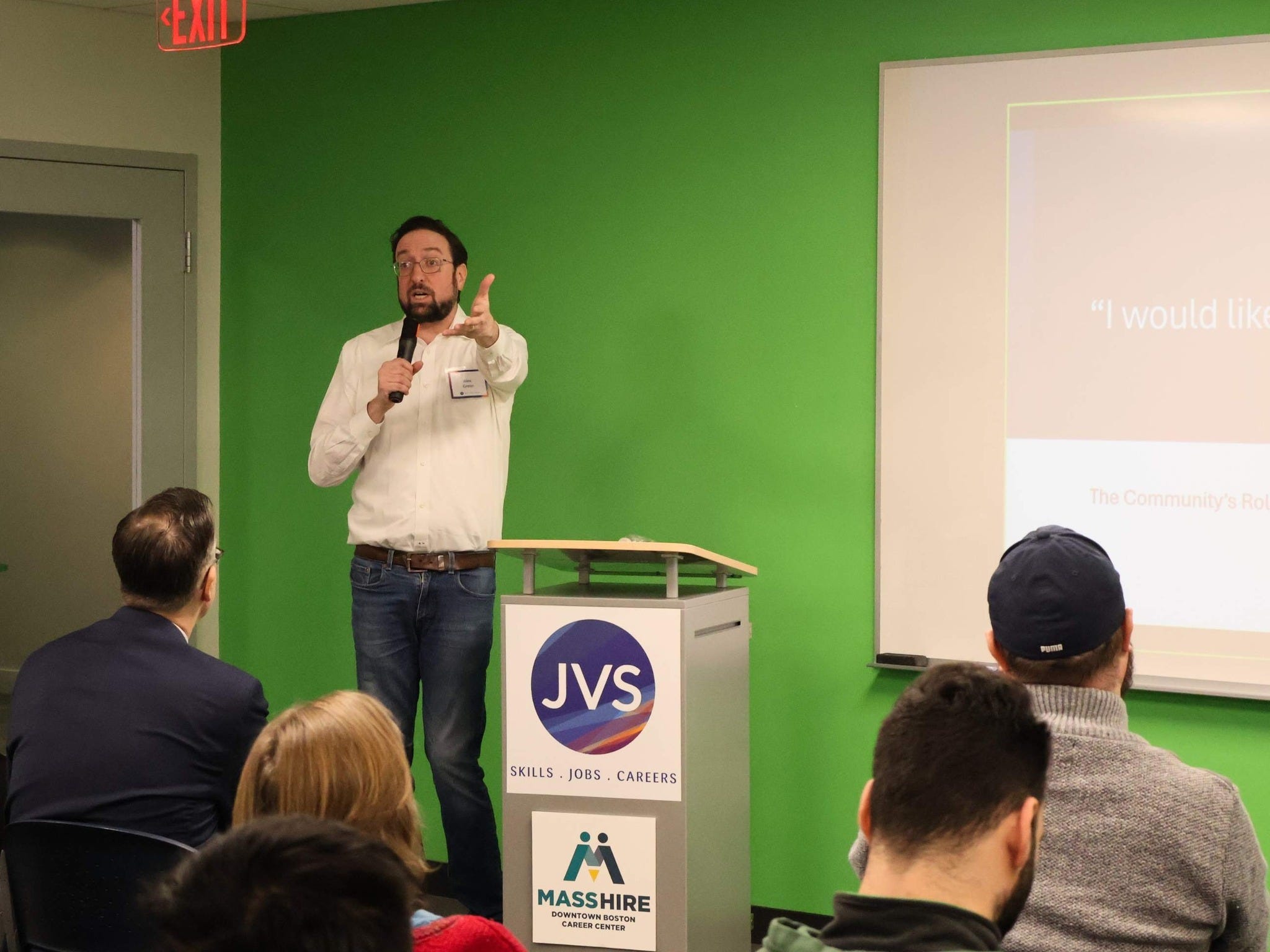
Image Description: Alex Green, a tall guy in a white oxford shirt and jeans, lectures on his book A Perfect Turmoil: Walter E. Fernald and America’s Struggle to Care for the Disabled at JVS Boston. You can spend the time you would need to read this post ordering Alex’s National Critic’s Circle Award Finalist for Biography from your favorite local bookseller. That’s a better way to spend your time. Get to it. Also, no, I am not horrified by the size of my bald spot. Why do you ask?
A few weeks ago, we had the privilege of welcoming Alex Green, a talented advocate, researcher, teacher, and writer, to JVS. His 2025 book A Perfect Turmoil: Walter Fernald and the Struggle to Care for America’s Disabled – a National Critic’s Circle Finalist for Biography – has significantly deepened my knowledge of the history of special education and the institutionalization of people with disabilities in Massachusetts and throughout our country. Alex’s book, in a manner similar to Dan Barry’s The Boys in the Bunkhouse, terrifies me.
In A Perfect Turmoil Alex carefully chronicles how charitable action taken with the best of intentions can go horribly awry. Walter Fernald was a gifted educator and physician. He took the superintendent’s position at what would become the Fernald School because he passionately believed that people with disabilities could be educated and could work productively in their local communities. Fernald took the school out of the crowded streets of South Boston and into highly valued, bucolic setting, not all that far from where people like Ralph Waldo Emerson, Louisa May Alcott, and Henry David Thoreau had set the early intellectual scene for the country in the environs of Lexington and Concord. Fernald carefully crafted and designed beautiful buildings that were resplendent with natural light and prized for their clever ventilation. And for all these efforts, Walter Fernald ended up becoming the father of a system of oppression and control that at its height in the 1960s segregated over 200,000 Americans from meaningful lives in their communities while relying on the inmates’[1] unpaid labor for its perpetuation.
Walter Fernald cut a channel through which he intended pure water to flow. But the waters quickly turned putrid, overran the banks, and would not be damned to any significant degree for generations after his death. Walter died in 1924. The highly influential institution that bore his name did not completely shutter until 2014 and there remain state operated, segregated disability institutions in Massachusetts and throughout the country until this day.
Near the end of his life, Walter determined that he had been wrong to institutionalize thousands of residents in Massachusetts and incite the institutionalization of hundreds of thousands of additional citizens throughout the country. As Alex detailed in his talk and his book, Walter and his team did outcome research on inmates of his institution that had been released and found that the majority had successfully integrated into their community, a number were married, and many were employed. Fernald shared his research with his fellow institutional leaders and advanced the idea that only people with disabilities who had the most intensive medical needs should reside in small capacity settings where they could receive the support they needed. But Fernald was also a realist. He understood that the flow of people with disabilities into often crowded and segregated institutional settings was unlikely to stop for three generations.
It must have been terrifying for Fernald to foresee such consequences without any power to stop them. I think that most people who enter special education or choose to invest their careers supporting people with disabilities as they access, work, and reside in the world do so with the best of intentions. The systems we participate in shift and evolve. My career began with a state issued invitation to volunteer in a sheltered workshop in Oklahoma in the summer of 1996. By 2007, I finally returned to a field that was preparing to sunset the sheltered workshops. My responsibility was working with young adults before or shortly after the end of high school to connect them to community employment and ensure they were not absorbed into the sheltered workshops we were sure the federal or state government would shutter. When we finally proceeded with the workshop closures in 2013 and 2014, we built a team that worked relentlessly to increase access to community employment, but we also ended a type of employment – however poorly paid, intermittent, and poorly supervised that it often was – that individuals and families had grown to rely on over 40 years. I realize that by expanding employment opportunities for some people with disabilities we foreclosed on other employment opportunities preferred by some people with disabilities.[2] I take great pride in how we approached the change. Throughout the process we lost only two or three members and families who preferred the sheltered work setting. Moreover, within 24 months of the transition, we had twice the number of people working in group supported employment in the community earning at least minimum wage or in competitive employment than the 115 people we had in the sheltered workshop when I started in 2007. However, my pride in the work we did is intertwined with empathy for those who experienced the change as loss. Moreover, I am fully aware that only God knows every unintended consequence of my efforts.
I am fully aware of the infinite capacity of the disability community and committed to replacing the systems of oppression that have burdened the community with pathways pointed toward opportunity. However, I also have empathy for Walter Fernald, Kenneth Henry of Henry’s Turkey Service, and, on some occasions, me.[3] The latter men started with good intentions – to educate, employ, and equip people with disabilities to transition into a more inclusive, integrated world. We cut channels for progress and were overwhelmed when consequences, intended and not, overflowed our banks.
I am haunted by images of overflowing channels. What sluices can I cut to safeguard against that overflow or, at least, reduce the most damage of my errors spilling onto a community I care so deeply about and have committed my career to?
More to follow. For the moment, sitting in this shit seems appropriate.
[1] Not my language. This language comes from the Fernald School and similar schools throughout the country.
[2] And many more of their parents.
[3] Leave it to the white guys to empathize with one another. I know, I know.
I’m a white guy empathizing. Enjoyed reading this.