

Christmas 2025
This Little Light

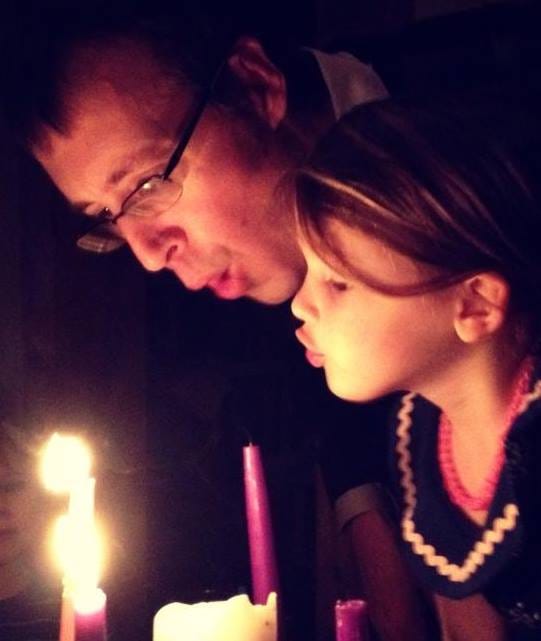
Last Tuesday it was heartening to pass Temple B’nai Abraham, the synagogue around the corner from our house, and see the parking lot packed for a Hannukah celebration. This is the same temple that an antisemitic nitwit from the neighborhood adjacent made plans to bomb in June. The cars testified that the light remained in the midst of the threatening darkness.
It’s that time of the year. Go to work in the dark, come home in the dark, and try not to freeze your ass off in between. Numerous religions have wisely chosen to situate religious and cultural celebrations in this season where we wait for the lengthening of the light. I’m not a religion scholar, but I doubt that religions like Christianity and Judaism and cultural traditions like Kwanzaa are alone in this respect.
My tradition often associates the divine with light. God, we are told, “is light and in him there is no darkness at all.” Jesus, who we believe fully embodies God, is “the light of the world.” When countering the darkness of the world, as our African American civil rights ancestors did so powerfully in the middle of the last century, they sang “this little light of mine.”[1]
When I was younger, I may have found the proliferation of religious and cultural traditions about light troubling. I was trained to believe that being the true light required Jesus to have an exclusive claim to divinity. Occasionally, I even claimed the latter belief as my own.
In later years, living in a world and metropolitan area deeply informed by and benefitting from globalization - which on a daily basis means building friendships and pursuing life and light with people whose differences in religions, national origin, and sexual preference are no cause for othering or alienation – I have found our collective turn towards the light so beautiful.
In the prologue to the gospel of John, Jesus of Nazareth is showered with metaphor. He is the Word of God and the Light of Men. John 1:5 reads, in the New International Version I once preached, “the light shines in the darkness, and the darkness has not overcome it.” I also love the old King James Version, which claims “the light shineth in the darkness; and the darkness comprehendeth it not.”
Both versions are beautiful. How can the darkness of this world understand or overcome the luminous, indescribable complexity of the particles and waves that we call light? If we do not believe that light can puncture and put darkness to rout – if only for moments or consistently on the longest of timelines – why persist?
Although I have long since shed my fundamentalist skin,[2] Jesus is still my source of light and life. If your source is elsewhere, the fire of Sinai, candles illuminating days of diaspora and brilliant resistance, or the sacred lengthening of light that we celebrated on December 21st, I hope to stand in the light with you in the year to come.
So illuminated, with brilliant faces and deepening unity, let’s bear the light into the world with the confidence that it will neither be comprehendeth by the darkness, nor be overcome.
Light and life to you and yours this holiday season!
[1] A song which we were raised to believe was about evangelistic zeal. I guess it can be interpreted that way, but I’ll take an anthem calling us to the practices of Jesus over one focused on proclaiming propositions about Jesus – substitutionary atonement for our sins, in this case – any day.
[2] With its adherence to the early twentieth century statement of faith titled, “The Fundamentals: A Testimony to the Truth,” and its later attempts to nearly divinize the Jewish and Christian scriptures with the concept of inerrancy, most expressions of American evangelicalism are akin to fundamentalism with a smile.
Lovely.
Hi Jeff, I’m glad I found your post today. Thank you. Light and lightness to you and yours!